|
![tn_fire12[1].gif (10884 bytes)](tn_fire121.gif)

MONARCH
CANADA'S MERCURY
BADGE - ENGINEERING
For A Smaller Market
Many of us from the Northern states remember that during the
1940s, '50s, and '60s, Fords and Mercurys from Canada wore
the Meteor or Monarch name plates. Ford trucks were also
badge-engineered and sold as Mercury's.
As a point of history, Ford was in business in Windsor, Ontario
by 1904, a year after the Ford Motor Co. was founded on
the other side of the Detroit River.
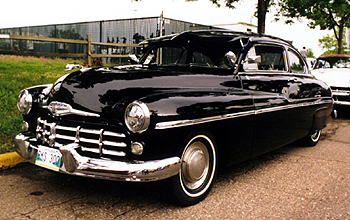
1949 Monarch Grill
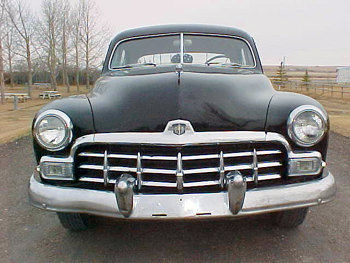
1950 Monarch Grill
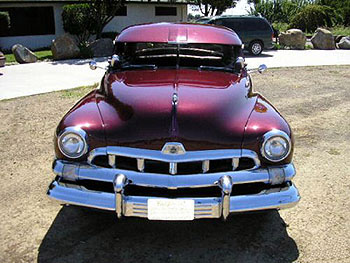
1951 Monarch Grill
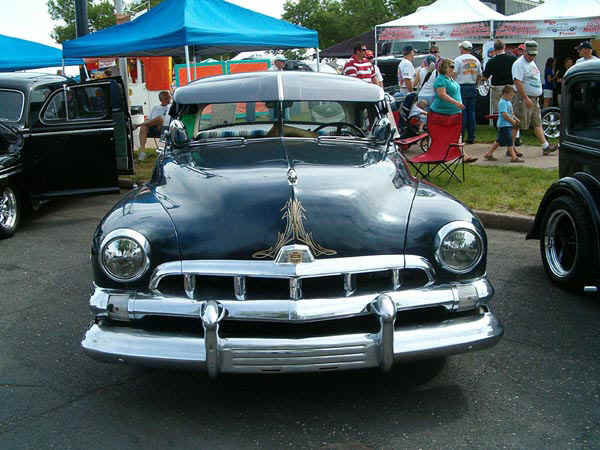
1951 Monarch Grill
The Meteor, Monarch cars and Mercury trucks first appeared
in April, 1946 because of Ford of Canada's postwar marketing
strategy. More lower-priced cars were sold in Canada than in
the United States because of the slightly lower standard of living,
not to mention whopping sales and excise taxes that added
almost 20 percent to the sticker prices across the border.
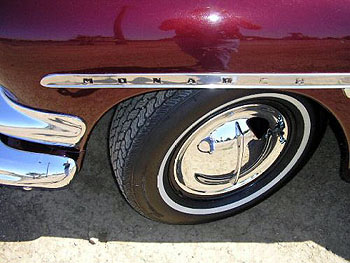
1951 Monarch Side Trim
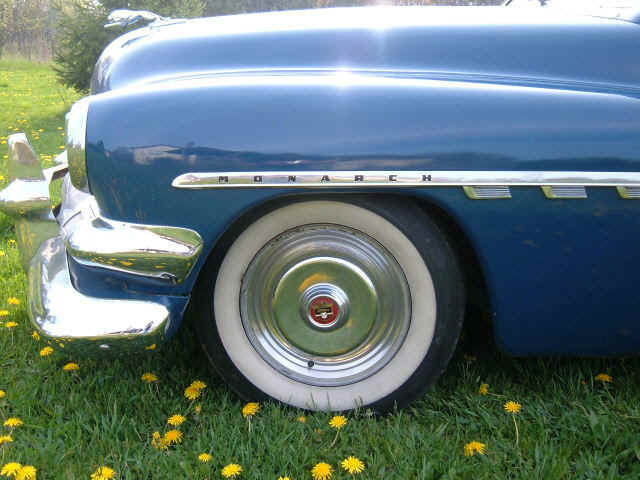
1951 Monarch Side Trim
To give the Canadian Lincoln-Mercury dealers a broader range
of cars that reached into the low-price market, they sold the
Meteor, a Mercury-ized Ford. To counter any sales advantage
from Lincoln-Mercury dealers' broader range, Ford dealers got
the upscale Monarch, a Mercury clone. Because smaller
Canadian towns had either a Ford-Monarch or
Lincoln-Mercury-Meteor dealer, but not both, the
L-M-M network got the Mercury truck.
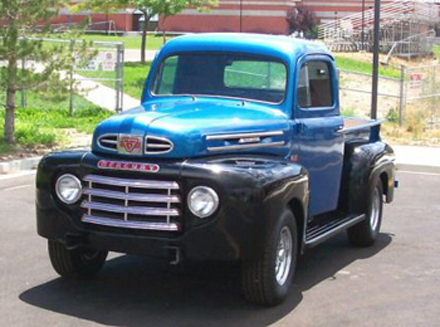
1949 Mercury Pickup Truck
Canadian-made Ford and
Mercury trucks differed, for the most
part, only cosmetically. Many years it was just "Mercury" versus
"Ford" letters on the hoods and pickup tailgates, plus distinctive
medallions that set them apart. Often there was a bit more glitz
on the Mercury trucks, in keeping with their slightly-more-upscale
image. As far as the dash plastic molding in 48-50, only the Mercury
had a kind of gray marble look, where Ford was tan in color. But
occasionally there were distinctly-different grille layouts. For
instance, like the American-built Ford trucks, Ford of Canada's
1946-47 pickups were warmed-over pre-war models, but the Mercury
trucks were treated to a heavily-chromed grille and bumper
treatment, compared to the Ford's plain looks.
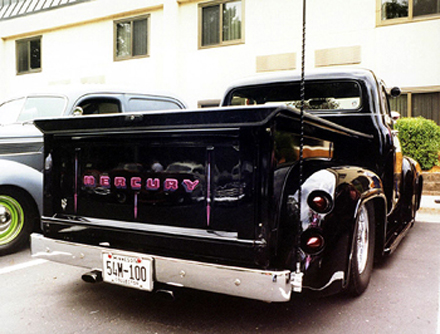
1956 Mercury Pickup Truck
(Customized)
Ford's first all-new postwar
vehicle was a truck and not a car.
Ford trucks got all-new sheet metal for 1948. Ford, Mercury,
Lincoln.... and in Canada, Meteor and Monarch.... cars were
all-new for model year 1949.
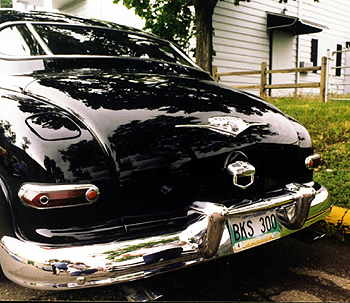
1949 Monarch Trunk Emblem
Incidentally, while the new
Monarch name plate appeared in 1946, the Meteor debuted in
1949. Before that, Canadian L-M dealers sold a Mercury-based
Mercury 118 (for its 118-inch wheel base) and a Ford-based
Mercury 114 (for the Ford's 114-inch wheel base.)
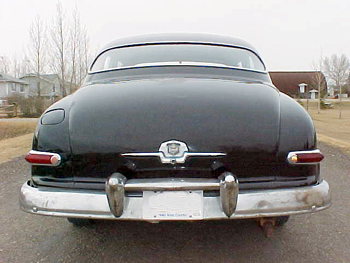
1950 Monarch Trunk Emblem
In 1948, Ford (USA)
introduced the F-1, F-2, F-3, etc. truck
nomenclature. Ford of Canada took a modified tact. It used an "M"
for the Mercury, in the place of the "F," but the numeral stood for
the truck's Gross Vehicle Weight rating, less the zeros. Thus, a
Mercury M-68-designated 6800 pound GVW-corresponded to
a Canadian Ford F-68. It got back in step in 1953 when Ford
switched to the current F-100, F-250, F-350 numbering scheme
with parallel M-100, M-250, M-350 designations for the Mercury.
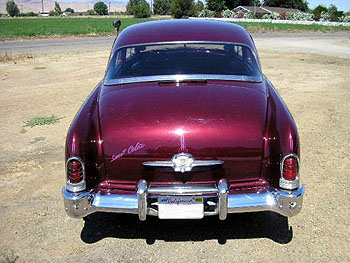
1951 Monarch Trunk Emblem
The mechanicals of both Canadian built truck brands were
virtually identical. Because of a smaller Canadian market, (Ford
of Canada roughly sold one-tenth as many trucks as its US parent).
Canadian buyers had a smaller menu to choose from in terms of
models, ratings and power-plants. While American Fords got an
all-new overhead valve V8 in 1954, the venerable flathead V8
soldiered on for another year in Canadian Fords, Meteors, and
Mercury trucks. Until 1956, only V8 engines were installed in
all Canadian Ford cars and trucks, since no six-cylinder Ford engines
were produced in Canada until the 223- cid six appeared in 1956.
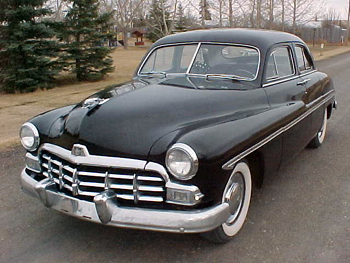
1950 Monarch Sport Sedan
The need for a dual marketing
network was eliminated with
the Automotive Trade Agreement signed by the United States
and Canada in 1965. The free-flow across the border brought the
phase-out of the Mercury trucks by March 23, 1968.
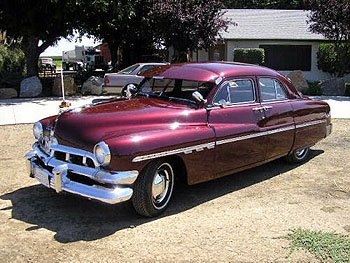
1951 Monarch Sport Sedan
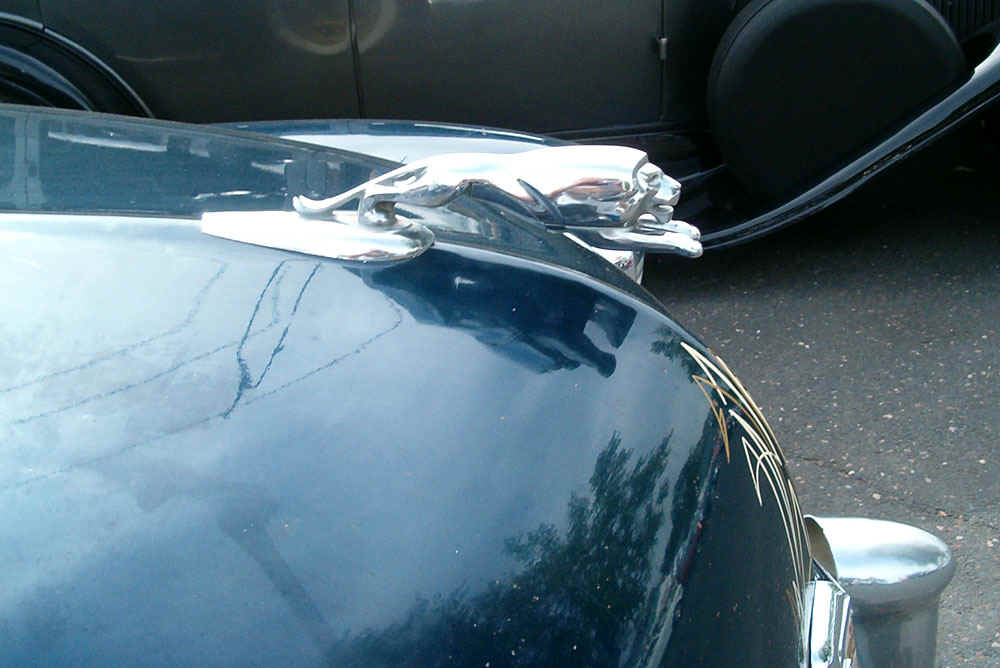
1951 Monarch Hood Ornament
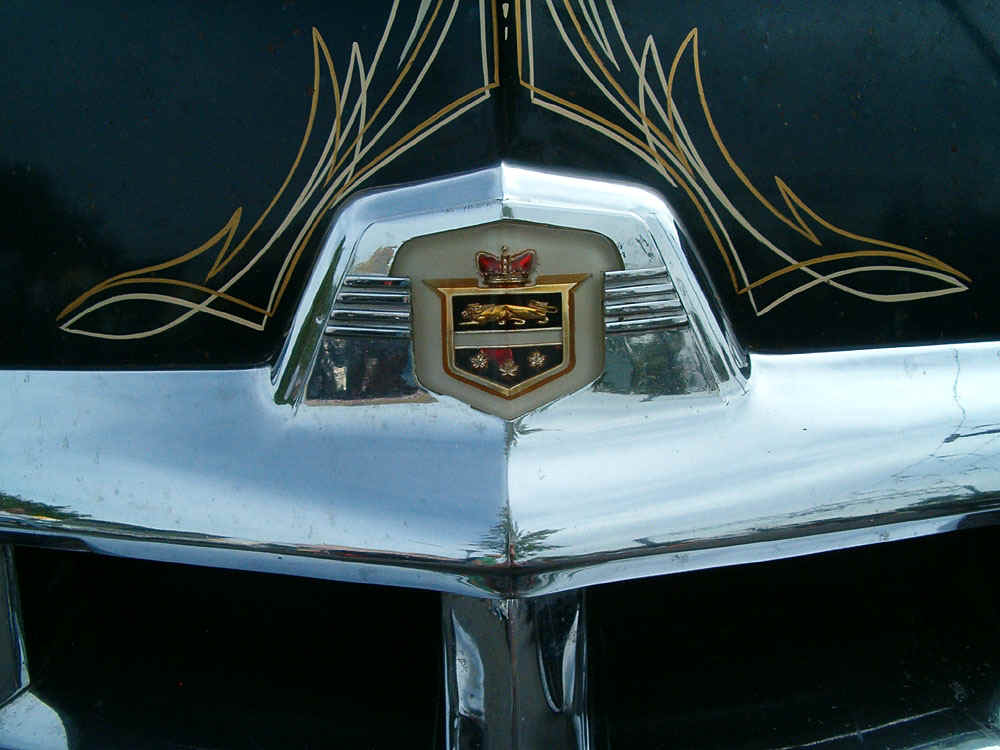
1951 Monarch Hood Emblem
This setup was not unique to Ford Motor Co. Pontiac dealers
in Canada sold lower-priced Pontiacs that were essentially
Chevrolets with Pontiac styling features. Canadian
Dodge-DeSoto dealers offered a Plymouth based Dodge model
and Chrysler-Plymouth dealers sold Fargo trucks that followed
the cloning philosophy of the Ford-built Mercury trucks.
|
|